Monday, June 8, 2009

Cendol

Cendol, a Malaysian Sweet Dessert, is a very interesting concoction. The dessert's basic ingredients consist of shaved ice, coconut cream, green noodles, and gula melaka/palm sugar. Sweetened red beans and Glutinous rice are optional additions. I liked watching how a big block of ice, held with a towel and shaved on a wooden stand with a blade which looked like the mandoline but a motorized device took over and it was not so fun watching anymore but, you get your bowl of cendol very much faster though.


Ingredients:

1 cup rice flour
2 tbsp mung bean starch
1/3 cup tapioca/cornstarch/potato flour
525 ml water
1 tsp kan sui
1 tsp pandan paste
1/4 tsp salt
Brown sugar syrup:
1/2 lb gula melaka/gula jawa,
1/4 cup sugar,
2 tbsp corn syrup,
boil together with 1/2 cup water until it dissolves.
Strain and set aside.
500 ml coconut cream
1/2 tsp salt
boil and set aside to cool.
Method:
How to make Cendol:

Mix rice flour, tapioca/cornstarch/potato starch and kan sui, then mix it with some of the water.
Microwave the rest of the water, green pandan paste and salt for 2 mins.

Put the flour mixtures into the boiled water. Stir well and cook in the microwave, 1 minute at a time, until it is cooked and thickened.
Fill the potato riser with the hot mixture and squeeze the cendol out onto a bowl of iced water. Shake Riser so that cendol will drop and make shorter strands.

Cendol will be solid in the iced water, drain and mix cendol with the cooled coconut milk.
How to serve:
Shave ice on to a bowl or tall glass, then scoop cendol coconut milk mixture and brown sugar syrup on top of shaved ice.
Enjoy


Serves

Saturday, June 6, 2009

Kuih Bahulu


I would like to thank Helen Ong, Bee Ling's mom who bought this mould and Bee Ling for bringing it back to me all the way from Penang. Without their kind gesture, making this kuih and keeping up with traditional kuih, will not be possible. Thank you.
Kuih Bahulu is traditionally Malaysian, it will be served during the Hari Raya and Chinese New Year. The moulds were made from cast-iron with a lid, of which lighted charcoal will be on it. Baking is done by putting the mould over charcoal. Thank goodness for the oven, otherwise the younger generation will not be introduced to these cookies. BTW, should this kuih be a cookie or a cake?


Ingredients:

2 large eggs
3 tbsp sugar
1/3 cup all-purpose flour + 1 tbsp(for friends in Denver)
1/2 tbsp cornstarch/cornflour
1/2 tsp vanilla extract
1/8 tsp baking powder
1 tbsp oil(optional)
Oil for greasing the moulds


Method:
For friends at sea-level where humidity is high, dry fry the all-purpose flour in a wok over the stove or put in a parchment paper lined microwave safe bowl and microwave - time depends on the amount of flour. Cool before using.

Arrange oven racks to the lower rung of the oven. Turn on oven to 425f.
Put the moulds in the oven while it is preheating, it should be about 10 minutes.
Grease the moulds and leave in the oven while you prepare the batter.
Sieve flour, cornstarch and baking powder 3 times and leave aside.
Heat an inch of water in a small saucepan of which the mixing bowl can sit on. Mixing bowl must not touch the water.
Bring the water to the boil and then lower fire so that water is only simmering.
Put in sugar into the mixing bowl and then the eggs - these 2 should only be put together, only when the water is simmering.
Place mixing bowl over simmering water and whisk until the egg mixture is warm to the touch - about 105 - 115f.
Remove from the saucepan and beginning whisking on high until mixture has cooled and doubled and reached the ribbon stage.
Add in the vanilla extract and then the flour. Fold in gently, do not overmix.
Fill the heated moulds 3/4 full of batter and put in to bake for 10 minutes.
Remove from oven and leave to cool for awhile before removing kuihs from mould.
Cool and keep in airtight container.
This recipe should be enough to make 24 kuih bahulus so it will help if you have 2 moulds which have 12 holes.


Serves

Friday, June 5, 2009

Rojak/Fruit Salad


"Rojak" is a Malay term for mixture, and, Malaysia, with its multi-ethnic society, used this word as a colloquial expression for this eclectic mix. This salad uses various fresh fruits and vegetables, of which pineapple, jicama and cucumber are a must. The rich flavor comes from the special, spicy, sweet sticky, peanut laden sauce and the fruits of various textures and colors truly represent Malaysia. To bring this dish to another level, add some crispy crackers or chinese yau char kway. I did not either, so i added some corn chips and it went well.


Ingredients:
Pineapple - cut into big chunks
Jicama - cut into big chunks
Cucumber - cut into big chunks
Grannysmith Apples - peeled, cored and cut into big chunks
Blanched Bean sprouts (optional)
Blanched Kangkung(water convolvulus(optional)
Corn Tortilla Chips


Sauce:

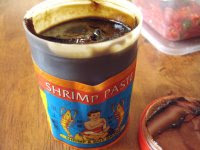
2 tbsp Hae Koh/Dark Prawn Paste/Petis Udang(see pic)
1 tbsp roasted belacan
2 - 3 tbsp sugar
3 tbsp thick tamarind juice
1 - 2 tbsp sambal olek (more if you like extra spicy)
1/2 cup hoisin sauce
1 cup chopped roasted peanuts
2 tbsp roasted sesame seeds


Method:


In a large mixing bowl, put in hae koh, roasted belacan and sugar and mix well to combine.


Add in sugar and the rest of the sauce ingredients. Stir to mix well, adjust taste.


Add the fruits and vegetables and toss.


Top with chopped roasted peanuts and roasted seame seeds.


Serve immediately with corn tortilla chips/crispy crackers.


Like any salad, this dish does not keep, it has to be served immediately. If leave to sit too long, the fruit and vegetable juices will dilute the sauce and it will not be good eats.


Serves


Thursday, June 4, 2009

Three's A Company


I don't know what this kuih is called and looking at the main ingredients which are only Three(3), thought it will be fun to call it so. I love this sitcom - Three's A Company and it has never failed to lift my spirit.
I am still in contact with my classmates, who went to school with me from the day we started until we left school and they are my dearest friends. Nancy, who is still staying in Temiang, and when we chatted lately, the both of us were reminicsing and i wanted to know if that handsome Philippino boy who used to sell kuihs, is still around. This banana, tapioca kuih was one of the many kuihs which he used to sell and i made it although i did not have the proper banana - pisang tanduk(horns).

Ingredients:
1 lb frozen grated cassava - thaw and drain
1/2 cup tapioca starch
3/4 cup sugar
2 cups water(use 400 ml if cassava is not drained)
Pandan paste
3 - 4 bananas(not too ripe and nos. depend on size)
1 cup grated coconut - white only
1/4 tsp salt


Method:
Steam grated coconut with salt for 5 - 8 minutes and leave aside for coating.
Put water, pandan paste, sugar, tapioca starch and drained cassava in a microwave-safe bowl and stir well to combine.

Microwave on high one minute at a time, stirring after every one minute. Cook until mixture has thickened and almost cooked.
Spoon enough cassava onto a greased cling wrap and flatten it to the length and width of the banana. Wrap banana totally with cassava and wrapped tightly.
Repeat with the rest of cassava and banana. When done, steam the parcels for 10 - 15 minutes to complete cooking the cassava.
Leave to cool, then remove the cling wrap and drop cassava onto steamed coconut.
Cut into bite-size and enjoy


Serves

Tuesday, June 2, 2009

Handmade Loh See Fun and Lai Fun


ALEXANDER'S LUNCH - Loh See Fun with shredded chicken and soup.


This was the result of the first batch of dough i made to make 'Putu Mayam'. Since i did not have the correct template for 'Putu Mayam' but i do have bigger holes template, Viola, the dough was pressed and steamed and became 'Lai Fun'.


These 'Loh See Fun' was hand-rolled. Pinch a tiny pea-size dough and rub it between your palms, the dough will form into a strip with both ends pointed. You might have to dust your palms with tapioca starch. When done, steam until cooked and serve them in soups of choice or 'kon loh' with fragrant oil, black thick soya sauce and c ooked ground pork. In Malaysia, we call this 'Loh Shi Fun' and in Hong Kong it is called 'Silver Needle Noodles' but it is made with 'wheat starch a.k.a. Tung Mein Fun'.
Recipe for dough, use the same ingredients and method as in Putu Mayam. Ground Pork Sauce goes very well with soup or 'kon loh'.


Serves

Monday, June 1, 2009

Putu Mayam/String Hoppers


BEFORE

AFTER

Putu Mayam is one of my favorites when i was a child which is a long long time ago. During that time, hawkers come to your doorstep, they will promptly be at your street, the same time everyday, some on bicycles, push carts and some on foot. Recalling some of these friendly hawkers who had become friends from our frequent beckonings, bring fond memories especially the Kacang Putih man, who will call me LULU. The Kacang Putih man and the Putu Mayam man were Indian, so, i have always assoicated Putu Mayam as an Indian Cuisine and indeed it is - a Sri Lankan Delight. I only realised that this light and satisfying snack was called 'String Hoppers" when i was able to read.

Making Putu Mayam was fun while it lasted, my arm muscles had improved from all the pressing - the texture of the dough had to be just right to fasilitate easy flow of noodles.

Putu Mayam has to be fluffy and dry, the strands of noodles, be the fineness ever and to achieved this, one has to have the proper size template to be used in a 'muruku mould'. I made a template out of a plastic jar cover and pricked very tiny holes in it. My first batch of Putu Mayam turned out to be thick beehoon and loh see fun, luckily the template worked and i succeeded making a batch of Putu Mayam to satisfy me.


Ingredients:

2 cups rice flour
2 tbsp tapioca starch
550 ml boiling water
1-2 tsp salt
1 cup grated coconut - white only - steam with 1/4 tsp salt

1/2 cup dark brown sugar
Parchment papers - perforated to make steam holes
A Muruku Press with a very fine template/Putu Mayam Press

Method:

Line basket for steaming with a clean napkin, put in the dry rice flour, steam for about 1 hour.

Put the rice flour and tapioca starch in a bowl. Pour boiling water, add salt all at once onto the flour, stirring with the handle of a wooden spoon until the flour is moistened. When cool enough, gather it together with the hand and ensure there are no pockets of dry flour by kneading lightly.
Fill Muruku/Putu Mayam Press with enough dough, squeeze dough through the fine holes in the Press at the same time moving the Press over each parchment paper, so that the fine strings fall in two circles.
Repeat making noodles and when done, put the noodles to steam over fast boiling water for 5 - 8 minutes or until noodles are cooked and translucent.
Remove from steamer, allow to cool slightly, then gently peel the putu mayam off the parchment paper away.
Serve with steamed coconut and brown sugar.
Enjoy

Serves

Friday, May 29, 2009

Assam Black Pomfret


Black Pomfret is one of the frozen fishes that somehow is just as good as one which has just come out of the water.
I had to show my guests around, we enjoyed ourselves so much that we forgot about the time. We were running very late for dinner, luckily the fish was taken out to thaw in the morning before we left home. So, cooking this dish was no effort as the assam spices was a premixed and pineapple was from the can. Only the tomatoes needed to be halves. Thank goodness for premixed spices and a well stocked pantry.

Ingredients:
1 black pomfret
1/2 salt
1 packet of Assam pedas (any brand will do - adjust taste with tamarind juice and sugar)
2 tomatoes cut into halves
1 can pineapple chunks

Method:
Clean the black pomfret of scales and salt the fish, inside and on the surface of fish.
Follow the instructions in the packet of assam pedas premix, add in the black pomfret. Cover and cook until fish is cooked. Adjust taste with tamarind juice if not sour enough, sugar and salt according to taste.
Add in tomatoes and pineapple chunks and bring gravy back to the boil.
Serve hot with white rice and enjoy.


Serves